Clever AI Detector Review: Is It Accurate?
Clever AI Detector is unusually capable for a free checker, especially on edited or humanized AI text. Its score is still a clue, not proof of authorship.
Clever AI Detector is accurate enough to be a useful screening tool, with a company-run August 2026 benchmark reporting a 96.7% detection rate across 600 AI-involved essays. Its sentence-level flags, confidence cues, 10,000-word allowance, plus honest treatment of uncertainty make it more useful than a bare percentage meter. Still, no detector score should be treated as proof.
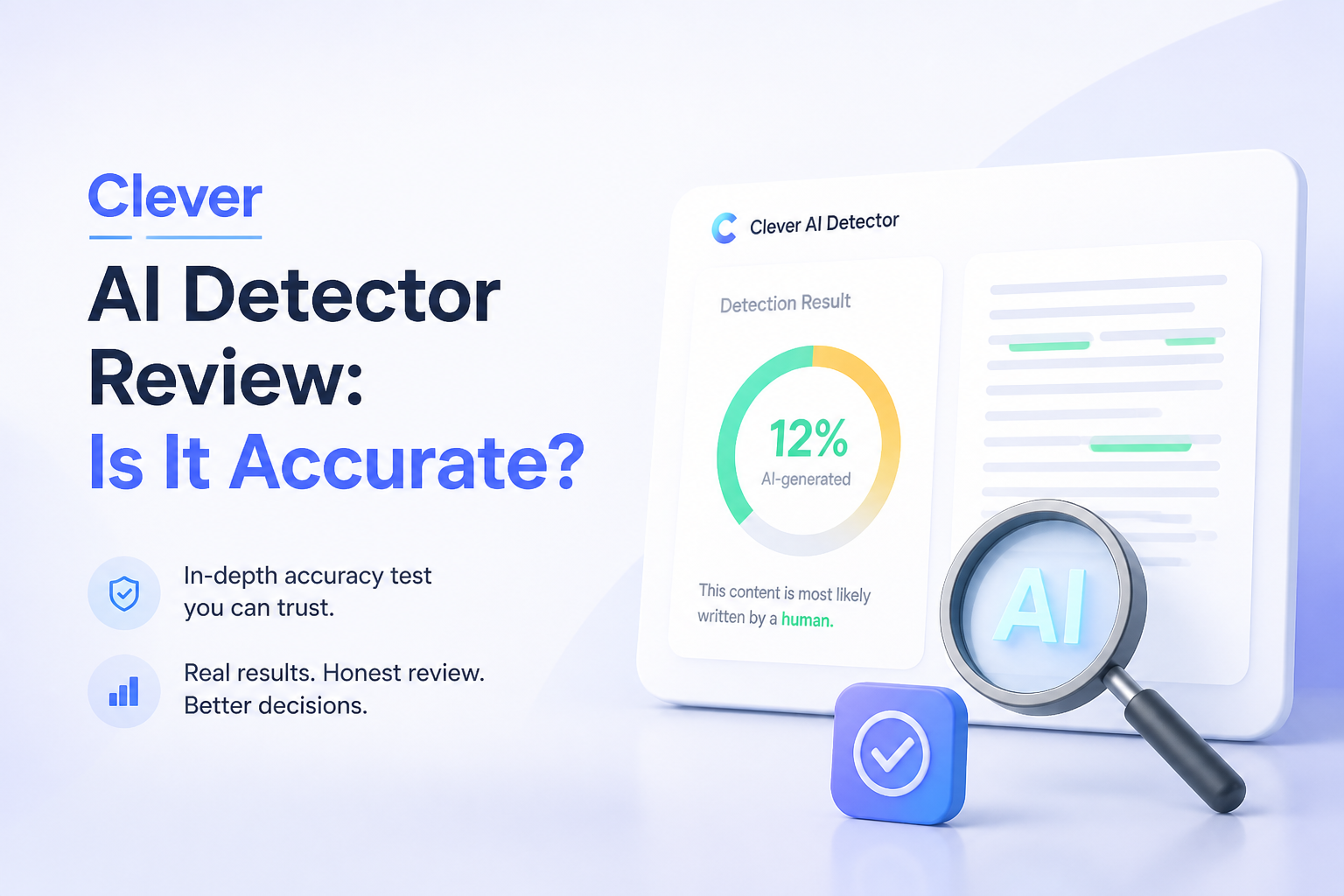
Clever AI Detector at a Glance
9.2/10Clever AI Detector is a browser-based checker that estimates whether English text resembles AI output. It returns an overall probability, confidence cues, plus sentence-level signals.
Best forEditors, teachers, writers, or reviewers who need a free first-pass signal on longer English text
- AI probability score from 0 to 100
- Sentence-level AI signals
- Confidence indicators
- Up to 10,000 words per check
- Optional check history
- No signup required
- Detailed results are free
- Clear uncertainty warnings
- English only
- Cannot prove authorship
- Benchmark needs outside replication
Clever AI Detector: How It Scored Across Our Review Criteria
| Category | Performance | Score |
|---|---|---|
| 01 Detection Accuracy | 9.6/10 | |
| 02 Result Explanations | 9.3/10 | |
| 03 Ease of Use | 9.4/10 | |
| 04 Limits Plus Access | 9.7/10 | |
| 05 Practical Reliability | 8.2/10 |
How We Evaluated Clever AI Detector for Accuracy
We reviewed the live product page, its limits, output format, privacy disclosures, plus the August 2026 benchmark methodology. Our accuracy score gives the most weight to performance on edited, rewritten, plus humanized AI text because raw chatbot output is the easiest case for nearly every detector.
We also checked whether the benchmark disclosed its dataset, sample size, thresholds, labeling choices, confidence limits, plus conflicts. The test used 600 AI-involved essays with 150 human controls from the public GEDE corpus. Since CleverFiles ran the comparison itself, we treated the results as useful product evidence rather than final independent proof.
When Not to Rely on Clever AI Detector
Do not use Clever AI Detector as the sole basis for accusing a student, employee, freelancer, or applicant of dishonest AI use. A high score shows that the language resembles patterns associated with machine writing. It does not reveal who drafted the ideas, how much editing occurred, or which tools were permitted.
It is also a poor fit for tiny excerpts, unsupported languages, confidential legal drafts, unpublished research, or any case where a wrong label could seriously harm someone. Ask for version history, notes, sources, or a short explanation of the writing process instead.
Clever AI Detector Accuracy, Features, Limits, Plus Real-World Use
01 Detection Accuracy
Strong results on more than raw chatbot output
9.6/10
Detection Accuracy
Strong results on more than raw chatbot output
The most useful evidence comes from the site's August 2026 benchmark. Clever AI Detector flagged 580 of 600 AI-involved essays, producing a 96.7% detection rate. It caught 100% of direct AI samples, 100% of machine-rewritten essays, 94.7% of AI-improved drafts, plus 92% of humanized AI text.
Those are impressive results, though the test was run by the company behind the detector. The GEDE corpus is public, the methodology is described in detail, plus the page acknowledges that Clever's lead over Copyleaks on overall recall sat within the margin of error. That restraint makes the findings more credible, but independent replication would still help.
- 96.7% recall in the published 600-text AI sample
- Stayed above 90% across all four AI categories
- Caught machine-rewritten text in the tested corpus
- Performed well on adversarially humanized samples
- Benchmark was conducted by the product's own company
- Results cover academic essays rather than every writing genre
- Live detector updates may change performance
02 Result Explanations
The score comes with useful context
9.3/10
Result Explanations
The score comes with useful context
Clever avoids pretending that a detector can know who typed a passage. It presents a 0–100 probability score, a confidence indicator, plus sentence-level signals showing which lines influenced the result.
This matters more than a flashy percentage. If a 700-word article gets flagged because of three formulaic sentences, an editor can inspect those lines rather than distrusting the whole draft. Results near the middle are treated as uncertain, which is the right way to frame a fuzzy classification problem.
- Sentence-level highlighting points to suspicious passages
- Confidence cues expose uncertain calls
- Probability language avoids absolute accusations
- Reports can be copied for later review
- Highlighted sentences do not prove machine authorship
- A precise-looking percentage may still be overinterpreted
03 Ease of Use
A clean paste, check, inspect workflow
9.4/10
Ease of Use
A clean paste, check, inspect workflow
The workflow is simple. Paste or upload an English passage, click the check button, then inspect the overall score plus marked sentences. No account is required for a basic scan.
The 80-word minimum is sensible because tiny samples contain too little linguistic evidence. A 10,000-word maximum also means most essays, reports, articles, or long submissions fit in one check.
- No mandatory registration
- Supports pasted text plus file uploads
- Results separate the overall score from sentence signals
- Large documents usually fit in one run
- English is the only clearly supported language
- Texts below 80 words cannot be checked
- No browser extension is listed
04 Limits Plus Access
A genuinely useful free allowance
9.7/10
Limits Plus Access
A genuinely useful free allowance
Clever AI Detector costs $0. The site lists unlimited runs, up to 10,000 words per check, no advertising, plus no paywall. Basic checking works without an account.
Creating a free account adds check history. That is handy if you want to compare a first draft with a revised version, though anyone handling confidential material should read the privacy policy before saving submissions.
- Full detector access costs $0
- Up to 10,000 words per check
- No fixed limit on the number of checks
- Optional account rather than a signup wall
- Free history for signed-in users
- Service access remains subject to availability
- Saved history may not suit sensitive documents
05 Practical Reliability
Useful evidence with firm limits
8.2/10
Practical Reliability
Useful evidence with firm limits
Clever is best used as a screening signal. In the published control test, it flagged 0 of 150 human essays. That is encouraging, but the sample was narrow enough that the true false-positive rate could still be as high as 2.5%.
The bigger issue applies to every detector. Human writing can be formal, repetitive, heavily edited, or statistically predictable. AI-assisted writing may contain substantial original thought. A score cannot recover the writing process, so draft history, source notes, version records, plus a short conversation remain stronger evidence.
- The interface openly says probability is not proof
- Published methodology lists key test limitations
- No human control essays were flagged in the reported run
- Scores work well as a prompt for closer review
- Cannot establish who wrote a document
- False positives remain possible
- Accuracy outside English academic essays needs more evidence
What Users Say About Clever AI Detector
One Reddit user called Clever AI Detector their go-to checker for reviewing assignments, mainly because it is free plus easy to rerun after revisions.
Is Clever AI Detector Accurate Enough to Use?
Clever AI Detector is one of the more convincing free AI checkers we have seen, especially when the input has been edited, rewritten, or passed through a humanizer. Editors, writers, plus educators can use it for triage, provided they inspect the highlighted sentences rather than acting on the headline score alone.
Skip it if you need courtroom-level evidence, definitive academic misconduct proof, multilingual checking, or certainty about a writer's process. No text detector can provide those things.
Check at least 250 words, inspect the marked sentences, then compare the result with draft history before drawing any conclusion.