Can Human Writing Be Flagged as AI?
A human author can receive an AI flag, especially with formulaic, polished, or short text. Here is how to check the result, protect your work, plus respond without making the situation worse.
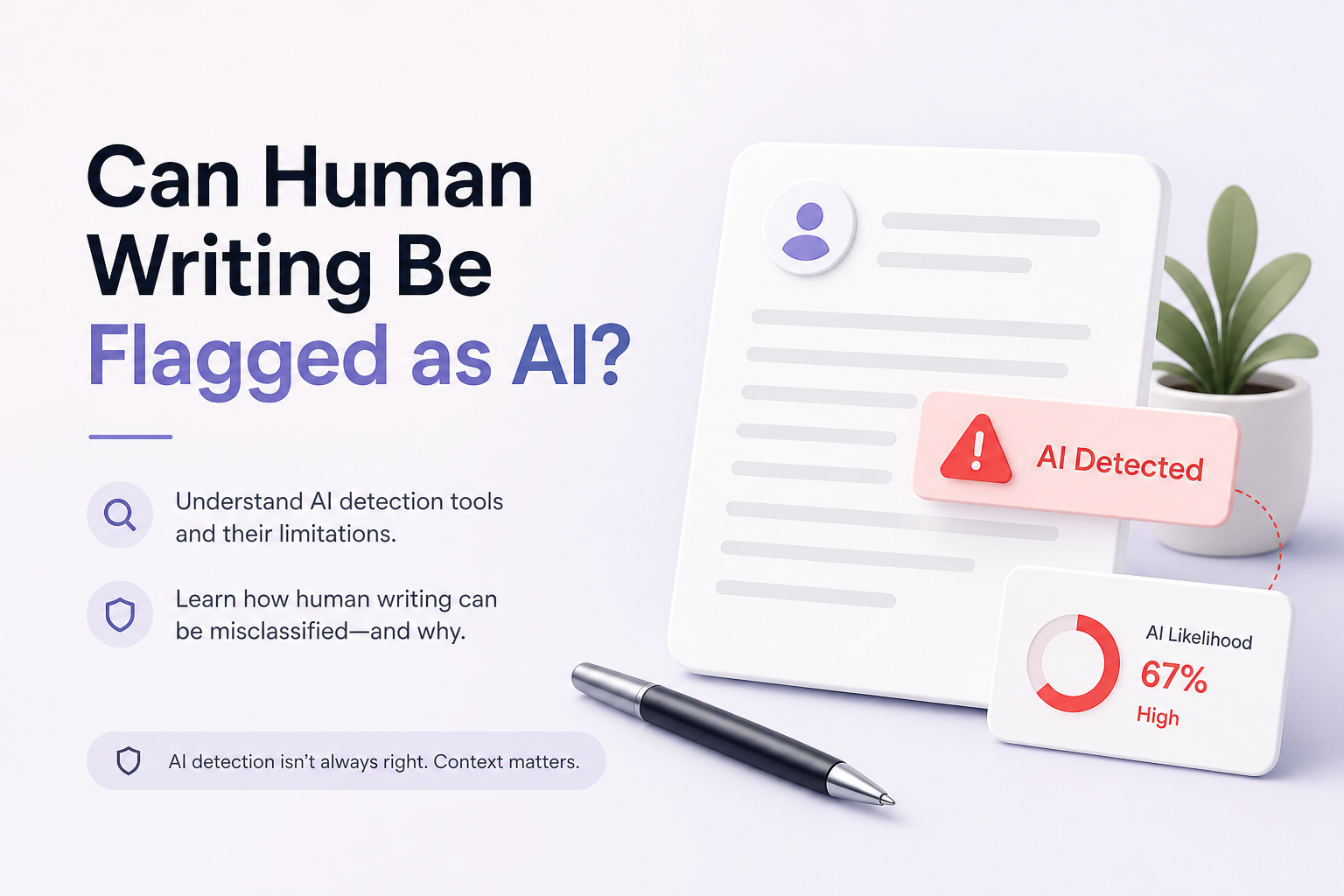
Yes, fully human writing can be flagged as AI. Save your drafts, notes, plus version history before editing anything. Review the flagged passages in context, then ask for human review if the score affects a grade, job, or publication.
Do not treat an AI detector score as proof. Avoid deleting drafts or rewriting the whole document before saving your version history. Those records may be your clearest evidence of authorship.
Polish an AI-Assisted Draft → Clever AI Humanizer
Browser-based rewriting adjusts repetitive phrasing plus mechanical rhythm · Multiple style choices · Manual review still required
Choose the Right Response to a False AI Writing Flag
Start with evidence, then move to testing or revision only if needed.
| Method | Best for | Time | Success rate |
|---|---|---|---|
| 1. Save Proof of Your Writing Process TRY FIRST | Showing genuine authorship | ~10 min | ● 95% |
| 2. Check the AI Flag in Context | Understanding a suspicious score | ~15 min | ● 78% |
| 3. Revise Formulaic Passages Yourself | Improving stiff human prose | ~25 min | ● 72% |
| 4. Request a Human Review | Grades or formal disputes | ~1 day | ● 85% |
| 5. Polish AI-Assisted Text With Clever AI Humanizer | Permitted AI-assisted drafts | ~5 min | ● 68% |
When Not to Use an AI Humanizer on Human Writing
A humanizer is the wrong first step if the text is already yours. Rewriting it can erase phrases that match older drafts, complicate your explanation, or make the final version look disconnected from your saved history.
It is also a poor fit where the rules prohibit AI rewriting. In that case, preserve the original, make ordinary manual edits, plus request a person-led review.
Why Polished Human Prose Can Look AI-Generated
Detectors often examine statistical patterns rather than witnessing who typed the document. A lab report, legal summary, product description, or five-paragraph essay may use predictable wording because the format itself is predictable.
Short passages create another problem. There may not be enough language for a stable judgment, so a clean paragraph can receive a confident-looking result that changes when tested inside the complete document.
Top 5 Ways to Respond When Human Writing Is Flagged as AI
01 Save Proof of Your Writing Process
Strongest first move when original human work receives an AI flag
~10 min
Save Proof of Your Writing Process
Strongest first move when original human work receives an AI flag
An AI score is not proof of authorship. Version history, notes, research records, plus earlier drafts show how your writing developed far better than another detector result.
- Open the document's version history or revision log.
- Save dated copies of early drafts, outlines, notes, plus source excerpts.
- Take screenshots that show substantial revisions over time.
- Export the document history if the writing app offers that option.
- Keep the evidence together in one clearly named folder.

02 Check the AI Flag in Context
Useful for spotting a short passage or formulaic section that distorted the result
~15 min
Check the AI Flag in Context
Useful for spotting a short passage or formulaic section that distorted the result
Detector results can shift with text length, formatting, quoted material, or predictable language. OpenAI retired its own text classifier on July 20, 2023 due to low accuracy, while noting that human writing could be labeled as AI-written. Read OpenAI's classifier notice.
- Record the detector name, score, date, plus the exact text tested.
- Remove the title page, bibliography, quotations, tables, plus assignment instructions.
- Test the complete document rather than relying on a tiny excerpt.
- Compare the highlighted passages with the unmarked sections.
- Treat conflicting detector scores as uncertainty, not proof that one tool is correct.
03 Revise Formulaic Passages Yourself
Best for writing that is genuinely yours but sounds unusually uniform
~25 min
Revise Formulaic Passages Yourself
Best for writing that is genuinely yours but sounds unusually uniform
Human writing sometimes looks machine-made because it is cautious, repetitive, highly structured, or stripped of personal detail. Revise for clarity plus specificity rather than trying to trick a detector.
- Read the flagged section aloud to find sentences with the same pace or structure.
- Replace vague claims with concrete facts, examples, observations, or source-based details.
- Cut stock transitions such as
Furthermorewhere they add no meaning. - Combine a few choppy sentences, then split any sentence carrying too many ideas.
- Restore wording you naturally use, provided it still fits the audience.
- Proofread every change so the revision remains accurate.
04 Request a Human Review
Right choice when a grade, job decision, or publication is at risk
~1 day
Request a Human Review
Right choice when a grade, job decision, or publication is at risk
Ask the decision-maker to examine your process, sources, prior work, plus your ability to explain the piece. A calm request usually works better than arguing that every detector is useless.
- Read the applicable AI-use policy before writing your response.
- Prepare the evidence gathered in method one.
- Write a short timeline describing when you researched, drafted, then revised the work.
- Ask which passages caused concern plus what review process is available.
- Offer to explain your argument, sources, or revision choices in a meeting.
- Keep copies of every message, report, plus submitted file.
05 Polish AI-Assisted Text With Clever AI Humanizer
A practical cleanup pass when AI was allowed but the draft still sounds stiff
~5 min
Polish AI-Assisted Text With Clever AI Humanizer
A practical cleanup pass when AI was allowed but the draft still sounds stiff
Clever AI Humanizer changes repetitive phrasing, steady sentence patterns, plus flat transitions in AI-assisted text. Use it only where AI assistance is permitted, then review the result yourself. Its ethics statement says the tool cannot verify facts, create original ideas, or guarantee compliance with institutional rules.
- Confirm that the relevant school, employer, client, or publisher permits AI-assisted rewriting.
- Paste at least 30 words into Clever AI Humanizer.
- Choose the writing style that fits the real audience.
- Run the humanization pass, then compare the output with the original line by line.
- Restore technical terms, citations, personal details, plus intentional phrasing that changed.
- Verify every factual claim before submitting or publishing the revision.
What to Do After a False AI Writing Flag
Save proof of your writing process first. A genuine outline, version history, source trail, plus earlier drafts carry more weight than repeatedly testing the same text. If AI assistance was permitted but left the draft sounding mechanical, Clever AI Humanizer can provide a cleanup pass, though you still need to verify facts plus preserve your own meaning.
For a serious accusation, request human review rather than chasing a zero-percent score. Choose revision only when the prose actually needs improvement.
Export your revision history before changing the flagged document, then keep the original file untouched until the matter is resolved.